In the News: More Is Riding on Every Repair Order
Fixed operations accounted for more than half of dealership gross profit in the second quarter, raising financial stakes for the records supporting each repair.
By Gregory Arroyo
CNBC recently turned a national spotlight on something dealers have understood for years: Fixed operations provides a measure of stability when other parts of the business become less predictable.
The difference comes down to margins. Kerrigan Advisors figures cited by CNBC put service margins at approximately 50%, versus 5% for new vehicles. In practical terms, $1 in service revenue can offset the gross-margin impact of losing $10 in new-vehicle revenue.
Current results put that contribution in perspective. Fixed operations accounted for 52.8% of total dealership gross profit during the second quarter, while its gross profit increased 5.2% from a year earlier, according to the Presidio-NCM Average Dealership Performance Benchmark.
That contribution is built one repair order at a time. What each record establishes can affect whether the dealership is paid — and remains paid — for the work.
The $5,851 Cost of Keeping a Car on the Road
The work documented on those repair orders has become increasingly expensive for vehicle owners. Car Dealership Guy reports that the average annual cost of vehicle ownership has reached $5,851. The article cites an AAA estimate showing that maintenance and repair costs in 2025 were approximately 23.5% higher than in 2019.
More recent federal data show that repair prices continued rising into 2026. The Consumer Price Index for motor-vehicle maintenance and repair was approximately 56% higher in August than in August 2019, according to the U.S. Bureau of Labor Statistics. Prices increased 5.2% during the latest 12-month period.
StoneEagle placed that repair-cost trend alongside changes in average F&I product income from 2022 through the first half of 2026 in its latest data review. The comparison provided context for the changing economics surrounding service contracts and other repair-related protection products.
A $1.9 Million Paper Trail
Those trends meet in the repair order. It documents work that has become more expensive while supporting a department generating more than half of dealership gross profit.
For a meaningful portion of that revenue, the record can be tested after the work is completed. Warranty labor and parts represented approximately 19.5% of franchised dealerships’ service and parts sales in 2025, or roughly $1.9 million per dealership, according to NADA data.
State dealer associations have secured stronger protections governing how warranty work is reimbursed. Dealer attorneys are also reporting increased manufacturer audit activity and resulting chargebacks, as we reported in July.

A manufacturer audit is not the only setting in which the repair order may be examined later. Repair orders can establish the chronology in lemon-law proceedings, preserve technician findings when a customer concern cannot be duplicated, and become evidence in a regulatory investigation or consumer dispute.
California’s Bureau of Automotive Repair illustrated that point in a case involving a wheel-bearing replacement. The work appeared on the invoice, but the repair facility had not properly recorded the customer’s authorization. BAR determined that the facility was not entitled to retain the full amount paid, and the shop agreed to refund the parts and labor and change its practices.
The significance is not the particular repair. It is that the business ultimately had to answer for the transaction through the record created while the vehicle was in the shop. What begins as a technician’s account of the work can later become the dealership’s account of what happened.
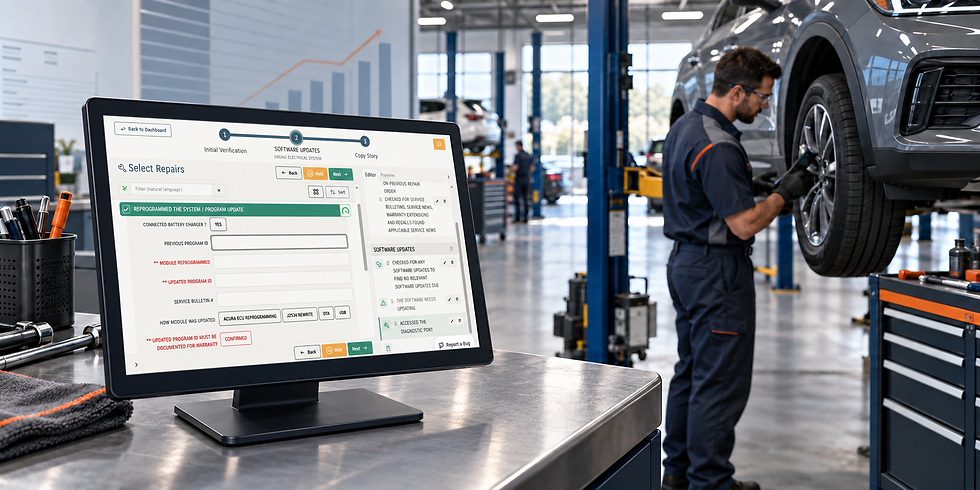
That makes the repair story a critical dealership record. Yet unlike sales, F&I and service-lane activity, it does not always follow a defined workflow intended to make important steps repeatable. Repair stories can still vary in terminology, sequence and level of detail from one technician to the next.
The opportunity is not to add another layer of review after the work is complete. It is to give the repair story a repeatable process of its own. One that carries service leadership’s standards into the record, helps technicians retrace the work, and reduces the need to reconstruct it after a claim or transaction is questioned.
The dealership is not paid for what its people know happened. It is paid — and allowed to retain what it was paid — based on what the repair order can establish later. As fixed operations carries more of the dealership’s gross profit, more is riding on the documentation behind every repair.
Complete the form below to sign up for the TCP Report newsletter, our monthly briefing on the latest benchmarks and industry data.



Comments